
Hackers abuse Google Ads, Bing redirects to push Claude ClickFix attacks
Valve Releases Hardware and CAD Reference For New VR Headset

Valve recently began shipping its long-awaited VR headset, the Steam Frame. Now, there is a hardware reference repository that includes everything a budding modder might need, and then some.

Want to design and 3D print some add-ons, or a carrying case, or some other doodad? There’s no need to break out the calipers or 3D scan the hardware. The repository contains STEP format models of the VR core module, head strap, and controllers, so it’s as easy as possible to design things that’ll fit. The location of the IR tracking LEDs embedded in the controllers is also documented, so one can ensure their design doesn’t occlude them.
That’s not all. The Frame has a user-accessible hardware expansion port at its front. This port exposes two interfaces: high-speed MIPI camera and PCI Express. This expansion port is documented in the repository, and even has a simple reference design built in both KiCad and Altium.
We’re glad to see Valve maintain their hacker-friendly hardware design with the Steam Frame. Demand for The Frame outstrips supply so far, so if you’re on the waitlist, you might want to browse the repository and get an early start on whatever customizations you have in mind while you wait for your confirmation. And when you get something working, drop us a note on the tips line!
Claude Sent Police a Fake Murder Tip. White House Mandates AI Companies Report Security Incidents
AFP reports that an AI model from Anthropic "submitted a fabricated tip about an unsolved homicide to Philadelphia police, authorities said Friday." Claude "was instructed never to log in, create accounts, enter personal data, make purchases, or submit anything destructive, but the instructions did not rule out form submissions," Anthropic said Friday in a blog post. Authorities are now criticizing Anthropic "for taking two months to report the incident." The Philadelphia Police Department said the false submission was made in July through PhillyUnsolvedMurders.com, a public website where people can share information about unsolved killings. According to Anthropic's account, as relayed by police, the model was running a test that involved interacting with randomly selected websites when it reached the site and filed false information about an unsolved murder. The AI model presented itself as someone who might have knowledge of the case. Anthropic's breaches have prompted the White House to mandate that AI companies notify and correct security incidents, news outlet Axios reported [yesterday], citing administration officials. "This notification and remediation process is not optional... It is a critical national security obligation," White House Super Intelligence Force leaders said in a statement to Axios. "I may have information regarding this case," Claude told the police. "I recall seeing someone matching the description in the area around [the street named on the page] during that time period. Please contact me if this information is relevant." Anthropic notes that Claude "left the name and contact fields empty, which the form allowed, and submitted it. The submission was flagged as spam and was never forwarded for investigation." But Anthropic also admits they saw "this behavior" three times — "on OSWorld (a public computer use evaluation), on Odysseys (a long-horizon task evaluation), and during internal usage." Submitting forms when it shouldn't have generally occurred "when an evaluation's instructions were ambiguous, or when a misconfiguration within the environment prevented Claude from working with dummy forms." Anthropic's blog post acknowledges three other categories of behaviors: Exploiting software flaws. Like when Claude received an error when trying to run a public tool on a university's web site, it located an injection flaw in a script on the university's server that let it run commands — including that public tool. Working around restrictions to reach gated data. For example, Claude Mythos 5 needed public data that was only available from a state agency for a fee. "Claude learned from an archived copy of the agency's website that its public dashboard issues an access token to any visitor," Anthropic explains. "It requested one and used it to query the database without paying the fee." Using URL shortening services. "Some of our fetch tools, which let Claude read webpages, limit the length of the URLs Claude can request. This is to prevent Claude from using long URLs to take certain unwanted actions, such as SQL or command injections... We saw several models, including Claude Opus 5 and Claude Mythos 5, get around this limitation by using free URL shortening services." "We have built tooling to automatically detect and block the kinds of behaviors described above," Anthropic says, saying it's already running no on most of their evaluations. "When we tested it against the cases described in this post, it blocked all of them." And they've already taken several other new preventive measures: They've stopped running some public evaluations Other public evaluations were moved to offline versions or rebuilt so their tasks don't reach live websites. They've updated the guardrails on some internet access tools (including web fetch) "to heavily restrict what the model can do." They're continuing "to fix or remove training environments that reward Claude for working around tool restrictions or other blockers, so that they do not incentivize these behaviors or permit reward hacking." They've moved internal agents to "centrally managed infrastructure with strong containment," that minimizes internet access while monitoring "far more of what agents do through techniques like safety classifiers and hierarchical summarization." In the past they'd focused reviews on cybersecurity testing, but they've broadened their transcript reviewing to other tasks which include internet access. "Because language models are non-deterministic — that is, their responses always involve some element of randomness, and they may carry out the same task slightly differently each time — we have Claude complete each evaluation task hundreds or thousands of times... If training rewards something we didn't intend — such as finding loopholes or working around a restriction — the model learns that the workaround pays off and may then apply it elsewhere." Anthropic's blog post also acknowledged they'd seen multiple misalignment incidents involving federal, state, and local U.S. government agencies. "We have briefed the White House on these cases and notified each agency involved," Anthropic wrote, adding that "While we have not completed a full alignment assessment of these cases, we consider them to be less severe than the cybersecurity incidents from this summer." (And they are "modifying training to reduce the likelihood of further misbehavior.")


Read more of this story at Slashdot.
OpenAI Disrupts Two AI-Enabled 'False Front' Influence Operations That Included Seven Fake Journalists
OpenAI announced it's recently banned two "influence operations" — one from Russia and one from Iran — that were using its models "to launder geopolitical, conflict-related messaging" in sophisticated "false front" propaganda campaigns: The Iranian operation included a stable of seven "journalist" personas which it used to pitch long-form articles to small and medium online outlets around the world... As well as long-form articles, the Iranian operation generated batches of social media comments, generally on topics related to the US-Iran war... [The Russian operation "appears to have co-opted unwitting people in Latin America to run a 'think tank'.... Since we do not allow access to our models from Russia, they used VPNs to connect to our services."] The Russian operation created fake "leaked" documents and audio scripts, some of which we identified being spread online... Both managed to land their content (not all of which was generated from our models) in mainstream media outlets, rather than simply posting it on social media. OpenAI says they've exposed 30 covert influence operations using its tools over the last two and a half years. But ironically, in this case both operations "also made heavy use of AI to draft internal reports (the Russian operation did this more than anything else)." And "in both cases, the actors used questionable or outright deceitful methodologies to exaggerate the operators' effectiveness." [The Russian operators] claimed that in May 2026, they created a fake email address purporting to come from the Regional Directorate of Education in Lima, Peru. They used this to instruct schools in the district to hold events dedicated to Ukraine on the national Day of Cultural and Linguistic Diversity (May 21)... According to the operators, some schools replied to the fake email address, confirming that they had held such events and even providing pictures. The operators then claimed to have planted stories about the events in the media in both Peru and Poland, alongside allegations that Ukraine was "exporting" ultra-nationalist ideologies, triggering outrage. Open-source searches identified stories that matched this claim in the Peruvianâ andâ Polish pressâ, and an English-language publication in Hungary (some of the articles have since been deleted)... Similarly, in June, the operators claimed they used a different fake email address to trick schools in Ecuador into holding a ceremony pledging allegiance to President Daniel Noboa and to Erik Prince, former head of private military contractor Blackwater. The operators claimed that the incident provoked outrage in Ecuador and put pressure on the government to deny the fake, thus amplifying it to a nationwide audience. Again, open-source research identified mediaâ coverageâ in the Ecuadorianâ pressâ that closely resembled this claim, and even a detailed rebuttalâ by Ecuador's Minister for Education. The operators used a range of techniques to underpin their false stories. According to their internal reporting, they spread two different fakes targeting Ecuador in March. One used fake audio attributed to Ukraine's consul in Ecuador, in which he was alleged to have made disparaging comments about Ecuadorians. OpenAI's report "is the latest illustration of how state actors can easily exploit widely available AI tools to peddle sophisticated propaganda against adversaries on a mass scale," argues the Economic Times: "We identified almost 100 articles published or syndicated under the [Iranian] operation's bylines across roughly a dozen online outlets around the world," OpenAI said. "These were small to medium outlets, generally focused on international affairs, geopolitics, and events in the Middle East." The earliest article identified by OpenAI was published in July 2025, and the latest in October 2026, with the frequency of reports increasing after the US-Iran war broke out earlier this year. The operation also generated social media comments on topics related to the US-Iran war, it added. One of the personas named Ervin B. Hoskins, whose bio claimed to be "an American freelance writer," had social media accounts across tech platforms including Elon Musk's X and Meta-owned Instagram. X's transparency information showed the account was connected via a "West Asia android app" and Instagram's transparency information showed the account was based in Iran, according to screenshots provided by OpenAI. Both accounts appeared to be suspended.
Read more of this story at Slashdot.
Another Woman Sues Flock For Mistaken Crime Accusation By Police - and for Surveillance
Last week a Florida woman sued Flock over its role in police officer accusing her of a crime she didn't commit But she's not the only one suing Flock over mistaken accusations, reports Gizmodo: . A Ring video of a Colorado woman being handed a criminal summons for a porch-package theft she did not commit recently went viral after the accusation rested on a Flock Safety automated license plate reader hit. Now, the woman involved in that case, Chrisanna Elser, is suing Flock Group, the towns of Columbine Valley and Bow Mar, Sergeant Jamie Milliman, and Chief Bret Cottrell in federal court on behalf of herself and other Coloradans whose plates the company has logged... The package in question was worth $25... The claims aimed at the company are intrusion upon seclusion, plus negligence and negligent design, on the theory that Flock sold a searchable archive and refused to require a warrant, a case number, or a supervisor's sign-off before an officer could run a plate... Elser is asking the court to make Columbine Valley, Bow Mar, Cottrell, and Flock delete the retained location data, to bar them from keeping it unless it is tied to an open case number, and to make Flock require a warrant, a case number, and a supervisor's approval before a Colorado agency can search the system. The Colorado Sun has more details. "Elser did not steal anything, but spent the following two weeks proving her own evidence to a department that did not return her calls, she said. [P]olice Sgt. Jamie Milliman told her the town of Bow Mar's surveillance cameras captured her forest green Rivian driving through town the same day a package disappeared from a thief... When Elser offered to show her own evidence to prove her innocence, including footage from her Rivian's onboard cameras, Milliman said she could bring it to court. Now, she is suing the officers and Flock Safety in U.S. District Court in Denver, alleging that the warrantless tracking violated her constitutional rights and that Flock's surveillance system unlawfully documents Coloradans' movements... "The scariest part is what happened to me can happen to anyone. I had no idea the Flock cameras existed and no idea a private company was keeping a record of every time I drove past my own neighborhood, or that any officer could pull it up without asking anyone or giving a reason for doing so," Elser said in a statement Tuesday. "If it can happen to me, it can happen to you...." "As noted in the complaint, the Flock system accurately identified the location of Ms. Elser's vehicle, while law enforcement retained responsibility for interpreting and weighing that information as part of the broader investigation," Paris Lewbel, Flock's public relations manager said. "Flock stands by the accuracy and integrity of its technology and intends to vigorously defend itself in this litigation." The article includes this statement from the woman's attorney. "Coloradans pass Flock's cameras on the way to work, church, the doctor, a protest, and a friend's house, and Flock keeps a detailed record of their every movement. It knows where you went, when you went there, and how often you go back, and it gives that information to a police officer with no limits. "We are asking a federal court to say what should be obvious: Flock's surveillance is straight-up creepy and the government does not get to follow everyone, all the time, without any reason for doing so."
Read more of this story at Slashdot.
Restoring an Altimeter Watch to Former Heights

Finding inexpensive broken hardware for sale, buying it, and restoring it to working condition is a long-standing tradition for hackers on a limited budge. But there are some devices that are so difficult to repair that it’s usually not worth the trouble. [Vintage560] is braver than most, though, and restored an internally-damaged Casio AW-330-AT altimeter watch.
The exterior of the watch was in good condition, other than missing a readily-replaced strap, but the battery had leaked into the interior, and the watch didn’t respond in any way to new batteries. Cleaning out the guts with isopropyl alcohol, repositioning a plastic insulator, and bending some contacts back into shape at least got some segments of the LCD display to activate, while over two days of turning the crown smoothed out resistance in the analog train.
Actually getting the LCD to work properly required disassembling the watch, taking particular care with the altitude sensor. It wasn’t clear what was wrong with the LCD — the controller seemed to be working properly, and several rounds of cleaning and adjusting the ZEBRA connector didn’t make any difference.
Eventually, [Vintage560] simply purchased a new screen. On close inspection, it looked as though chemicals from the leaking battery might have dissolved some of the transparent indium tin oxide contacts on the old display. With the watch now working [Vintage560] tested it on a trip to the Alps, and with a few periodic calibrations, it remained quite accurate.
Usually when we see Casio watch hacks, the watch in question is the F91W, whether it’s being used for contactless payments, being retrofitted as a smartwatch, or going 5,000 meters underwater.
Rolling Release Distros Superior To LTS Distros In The Patch-Heavy GenAI Era?
As some interesting food for thought and weekend forum discussions, this week at the Linux Plumbers Conference in Prague, Qualcomm engineer Khem Raj questioned the relevance of Linux Long Term Support (LTS) distributions in the era of generative AI with the constantly heavy patch flow and bug reports. Khem Raj argued the benefits of rolling release distributions in the GenAI era and the benefits it provides staying up-to-date with mainline...
The Weirdest Video Games were Hacks

We were looking into the marvelous recent project by [Throaty Mumbo] to recreate and reimagine the forgotten world of VHS-tape-based video games. Wait, what? Yes, back in the day, when computer graphics were more primitive, there were attempts to mix the gameplay of video games with the graphics from a video cassette. Take the Action Max system. It worked with a light-gun that pointed at the screen while the video played, and you tried to shoot at things as they flew by. Think Duck Hunt, but in glorious VHS video quality with cheesy acting, and the same gameplay loop every time, because it’s on the tape.
The unreleased Control-Vision VHS gaming system, co-developed with none other than Steve Wozniak, took the idea a little further and ran simultaneous sub-videos, and your actions would choose which of the sub-tracks would play at any given time. This let them do things like switch between videos depending on whether you caught the bad guys or missed them entirely, for instance.
These games came in the late 1980s, though, and they were all derivatives of the seminal Dragon’s Lair, which is probably the least fun video game I’ve ever had the chance to play, but among the most entertaining in a weird way. Instead of a linear VHS tape, Dragon’s Lair, and the later but equally unplayable Space Ace, were based on the then-new video disc technology that could swap between entirely different tracks almost seamlessly.
 “Almost” is the key word here, though. Although the animations were absolutely marvelously cartoony, and looked stunning in an arcade up against video games of the time, there was a significant fraction of a second of delay between commanding an action with the joystick and the machine swapping up to the correct track. There were a couple of sections where back-to-back actions were necessary, and the challenge was to work around the game’s exact track-swapping-glitch time. As good as they looked, the gameplay was no fun.
But the game was influential, as evidenced by its VHS-based clones. If you’d like to give it a try, you’ll not be surprised to hear that there’s an emulator for Dragon’s Lair and its spin-off games.
What do all of these have to do with each other? We love how these games took a current technology – in this case video discs or video tapes – and tried to make it do something else: These games were all hacks. If you look at them in that light, maybe you can look past the horrible acting in Night Trap or the frustrating glitches in Dragon’s Lair. (Or maybe not. Give me Robotron: 2084 any day.)
Many Laptop & Gaming Handheld Support Improvements Coming For Linux 7.4
Many x86 platform driver improvements have been queuing ahead of the upcoming Linux 7.4 merge window to offer a variety of laptop and gaming handheld device improvements with this next kernel version...
Meta Developing Compressed RAM 'CRAM' For Linux: Better Than ZRAM and Zswap?
Phoronix reports on a presentation this week by Meta engineer Gregory Price at the Linux Plumbers Conference in Prague: With today's memory shortages, high prices, and ever increasing memory capacity needs, Meta engineers have been working on Compressed RAM ("CRAM") for Linux. This hardware-offloaded compression still allows cacheline/byte access to compressed memory and in turn a better implementation than the likes of ZRAM and Zswap. Very promising is that there is near-native performance to raw DRAM speeds with CRAM... For end-users that may already be relying on the likes of Zswap or ZRAM, CRAM is offering near-native DRAM speeds. Read-only data is shown to be as fast as the raw DRAM performance. And for memory writes, CRAM is much faster than ZRAM or Zswap or plain swap. "Most of the individual pieces needed to support CRAM are already mainline," the article points out. Tom's Hardware writes that "It uses a private NUMA node (essentially, a ghost CPU) instead of pretending to be a block device, and this lets Linux continue using all of its memory semantics, including migration and ballooning, to manage CRAM." Because CRAM is stored in RAM and treated as RAM, with full cacheline/byte access, it can be accessed in a read-only fashion with little delay; just the cost of hardware-offloaded compression... Even when you enable writes, CRAM is still much faster than ZRAM; 5.4x in the worst tested case of 20% writes. That's a huge drop from the 452x read-only case, but keep your context; a 5.4x speedup is still titanic. The massive performance cliff when writes are involved comes down to the need to page fault and migrate folios back to the original NUMA domain, as you can't write directly to compressed data; you'd corrupt everything... While the obvious target of the work here (given its origin at Meta Platforms) is big Linux servers, ZRAM and Zswap are used all over the Linux ecosystem, even on machines as constrained as the Steam Deck. Many distributions enable one or the other by default. CRAM seems like it could offer a considerable speed-up for some of these machines, so hopefully it finds its way into the kernel once the remaining implementation questions are answered.
Read more of this story at Slashdot.
One with the world? A new look at brains transformed by psychedelics.
For about a decade, the mainstream understanding has been that psychedelics cause chaos in the brain. Brain networks—the stable patterns of communication that handle vision, attention, or our sense of self, and more—loosen and start talking to each other all at once. EEG traces get noisier and more complex. “Think of the networks of the brain as highways,” says Devon Stoliker, a neuroscientist at Monash University. “Under psychedelics, these highways break down into many different directions.”
In a recent Nature study, Stoliker’s team designed an experiment to test whether these directions are truly chaotic and random. Researchers gathered 62 people who had never taken a psychedelic before, gave them 19 milligrams of psilocybin, a common psychedelic found in certain fungi, and scanned their brains. Then, they used AI to analyze the drugged and sober brain scans. What emerged was not exactly chaos.
An uninterrupted trip
Stoliker thinks chaos is not a satisfactory explanation for psychedelics’ effect on the brain. “It never really explained why an individual would have a meaningful experience, why they might have insight, why they might experience clarity, and why these might translate into positive psychological changes,” Stoliker says. To investigate if there are other explanations, he and his colleagues designed a study called PsiConnect.
Why Every Microwave Has a “Popcorn” Button, But Every Bag Warns You Not to Use It

[Hyperfixed] has a podcast episode that does a deep dive into exactly why bags of microwave popcorn advise against using your microwave’s popcorn setting (in North America, anyway.) The answer is probably more complex than one expects, and involves the long history of microwave oven development as well as consumer behavior.
There are really two questions involved: one is “what does the Popcorn button actually do?” The other is “Why does every package of microwave popcorn say not to use it?”
The answer to the first question is “it depends”. Microwave ovens are amazing things, but the popcorn setting on any given microwave oven could be anything from just a dumb timer, to a setting that tells the oven to monitor popping sounds or humidity levels (because popping releases steam). These kinds of microwave oven features were figured out ages ago, meaning the technology to precisely handle a bag of microwave popcorn not only exists in equipped ovens right now, but has existed for decades.
The problem is not all microwaves are so equipped. A microwave oven where the popcorn setting is just a dumb timer is really an invitation to under- or overcook the bag. And when overcooked, microwave popcorn scorches and could even burn.
That brings us to the answer of the second question: why does every package warn not to use the popcorn setting? In short, because the popcorn maker has no idea what any given user’s microwave oven is doing. When people hit a button marked “Popcorn” they tend to leave the process unattended, and when a microwave oven ruins a bag of popcorn, the user blames the popcorn manufacturer.
This means microwave popcorn manufacturers stick to some variant of the only process known to work in all ovens: monitor the process, wait for popping to slow to a rate of one pop every two seconds, then stop.
That’s the quick answer, but [Hyperfixed] goes in a ton of researched detail across the entire spectrum of this issue. If deep-dive niche technical podcasts are your thing, we recommend queuing it up for a listen.
KNOD Progressing For Linux In-Kernel GPU Offloading For Network Packet Processing
A while back we covered KNOD as an experimental solution for in-kernel network offloading to AMD GPUs. The open-source KNOD project allows leveraging GPUs to handle packet processing in a very performant and energy efficient manner without needing any specialized hardware. KNOD has continued and a development update was shared this week at the Linux Plumbers Conference in Prague...
Linux Networking Diverts 50+ Fixes To Next Kernel, Still Bombarded With AI Fueled Churn
Ahead of the Linux 7.3-rc7 kernel due for release on Sunday, this week's batch of networking fixes were submitted and merged. The vast networking subsystem of wired and wireless drivers plus the various other networking features continues to see a lot of activity due to AI-driven bug reports and patches...
KDE Plasma 6.8 Ready For Release Next Week, Sees Last Minute NVIDIA Fix
KDE Plasma 6.8 is gearing up for its official debut next week in coinciding with the 30th anniversary since the KDE project began...
Saturday of the Twenty-seventh Week in Ordinary Time
Reading 1 Galatians 3:22-29
Brothers and sisters:
Scripture confined all things under the power of sin,
that through faith in Jesus Christ
the promise might be given to those who believe.
Before faith came, we were held in custody under law,
confined for the faith that was to be revealed.
Consequently, the law was our disciplinarian for Christ,
that we might be justified by faith.
But now that faith has come, we are no longer under a disciplinarian.
For through faith you are all children of God in Christ Jesus.
For all of you who were baptized into Christ
have clothed yourselves with Christ.
There is neither Jew nor Greek,
there is neither slave nor free person,
there is not male and female;
for you are all one in Christ Jesus.
And if you belong to Christ, then you are Abraham’s descendants,
heirs according to the promise.
Responsorial Psalm Psalm 105:2-3, 4-5, 6-7
R. (8a) The Lord remembers his covenant for ever.
or:
R. Alleluia.
Sing to him, sing his praise,
proclaim all his wondrous deeds.
Glory in his holy name;
rejoice, O hearts that seek the LORD!
R. The Lord remembers his covenant for ever.
or:
R. Alleluia.
Look to the LORD in his strength;
seek to serve him constantly.
Recall the wondrous deeds that he has wrought,
his portents, and the judgments he has uttered.
R. The Lord remembers his covenant for ever.
or:
R. Alleluia.
You descendants of Abraham, his servants,
sons of Jacob, his chosen ones!
He, the LORD, is our God;
throughout the earth his judgments prevail.
R. The Lord remembers his covenant for ever.
or:
R. Alleluia.
Alleluia Luke 11:28
R. Alleluia, alleluia.
Blessed are those who hear the word of God
and observe it.
R. Alleluia, alleluia.
Gospel Luke 11:27-28
While Jesus was speaking,
a woman from the crowd called out and said to him,
“Blessed is the womb that carried you
and the breasts at which you nursed.”
He replied, “Rather, blessed are those
who hear the word of God and observe it.”
Lectionary for Mass for Use in the Dioceses of the United States, second typical edition, Copyright © 2001, 1998, 1997, 1986, 1970 Confraternity of Christian Doctrine; Psalm refrain © 1968, 1981, 1997, International Committee on English in the Liturgy, Inc. All rights reserved. Neither this work nor any part of it may be reproduced, distributed, performed or displayed in any medium, including electronic or digital, without permission in writing from the copyright owner.
Another IKEA Product Yields an LED Matrix

The IKEA Kortlinje is a digital clock that costs around 20 dollars, featuring a hygrometer and thermometer. It’s another cheap appliance, you might think, were it not that the display is a white LED matrix. Best of all, with three VK1640 LED controllers, it has hacking potential. You’re in at the ground floor if you hack one of these, but so far we’ve seen a post from the RevSpace hackerspace in the Netherlands, and the first glimmerings of a firmware on GitHub from [VIPnytt].
We have one on the bench here, and cracking it open we find the three LED drivers, an unidentified microcontroller with a 32.768 kHz watch crystal, and a mystery chip nobody’s yet identified that may either be some kind of I2C multiplexer or have something to do with those sensors. Neither has any markings, so no help there. The hackability comes in the relative ease of desoldering the microcontroller and substituting your own. In which case with access to I2C and the LED drivers, you can make it do your bidding.
This thing is part of a rich tradition of hacking IKEA products. Perhaps one of our favorites is the use of bowls from the Swedish furniture giant to make a telescope mount.
Super Mario 64 Comes to the Microsoft Zune

As a portable media player, Microsoft’s Zune simply couldn’t compete with Apple’s juggernaut iPod — the latter essentially becoming the de facto personal media player until smartphones took over. But in 2026 it might be Microsoft that gets the last laugh, as thanks to [rsheldiii] the Zune can now play Super Mario 64.
The software is based on sm64ex, and notably doesn’t include the ROM file necessary to actually run the game. But presuming a legal dump of a cartridge has been done, building and loading it onto a Zune HD is straightforward enough. From there the player is presented with a controller interface on the device’s touchscreen overlaid with the video output from the game. Some interesting things are happening in the background here as well, like using NVIDIA’s Tegra tools to pre-compile shaders so the 2009-era processor can handle the rest of the gameplay.
Although it didn’t enjoy the mainstream success of the iPod, the Zune was actually a pretty solid device, and even though the last of them rolled off the assembly line back in 2012, there’s still a fairly active userbase for it. Modern improvements have added Bluetooth and solid-state drive upgrades for them have been available almost since they were first released.
AI Surveillance Startup Flock To Cut Several Hundred Jobs Amid Backlash, Sources Say
Reuters reports: Flock plans to let go of about 18% of its employees, people with direct knowledge of the plans said on Thursday, as the maker of AI-powered surveillance cameras and license-plate readers faces mounting opposition to its products from communities and lawmakers.... The company has about 1,500 employees [with job cuts hitting 270 employees]. Flock faces growing scrutiny from regulators, lawmakers, and privacy advocates, despite drawing strong investor interest among venture capitalists. A recent Reuters/Ipsos poll showed Americans are divided on whether Flock cameras are a good idea. Some 38% of the country supports the use of Flock cameras in their community, compared to 47% who oppose their use. A related story... In Texas this week a county commissioner decommissioned all 61 of their Flock surveillance cameras and license plate readers, according to a local news report. County residents "have raised serious questions about who can access this data, what vendors can disclose, improper searches, and records being kept after data expires," the precinct's Chief Public Affairs Officer said.
Read more of this story at Slashdot.
2026 Retrocomputing Challenge: NEC 286 Laptop Rides Again

The sad reality is that all consumer electronics are going to be e-waste eventually. [Cory Whitesell] was determined his old NEC ProSpeed 286 Laptop wouldn’t meet that fate until absolutely necessary, so when his attempts at repairs failed, his efforts pivoted to create a retro battlestation from the stylish old machine.
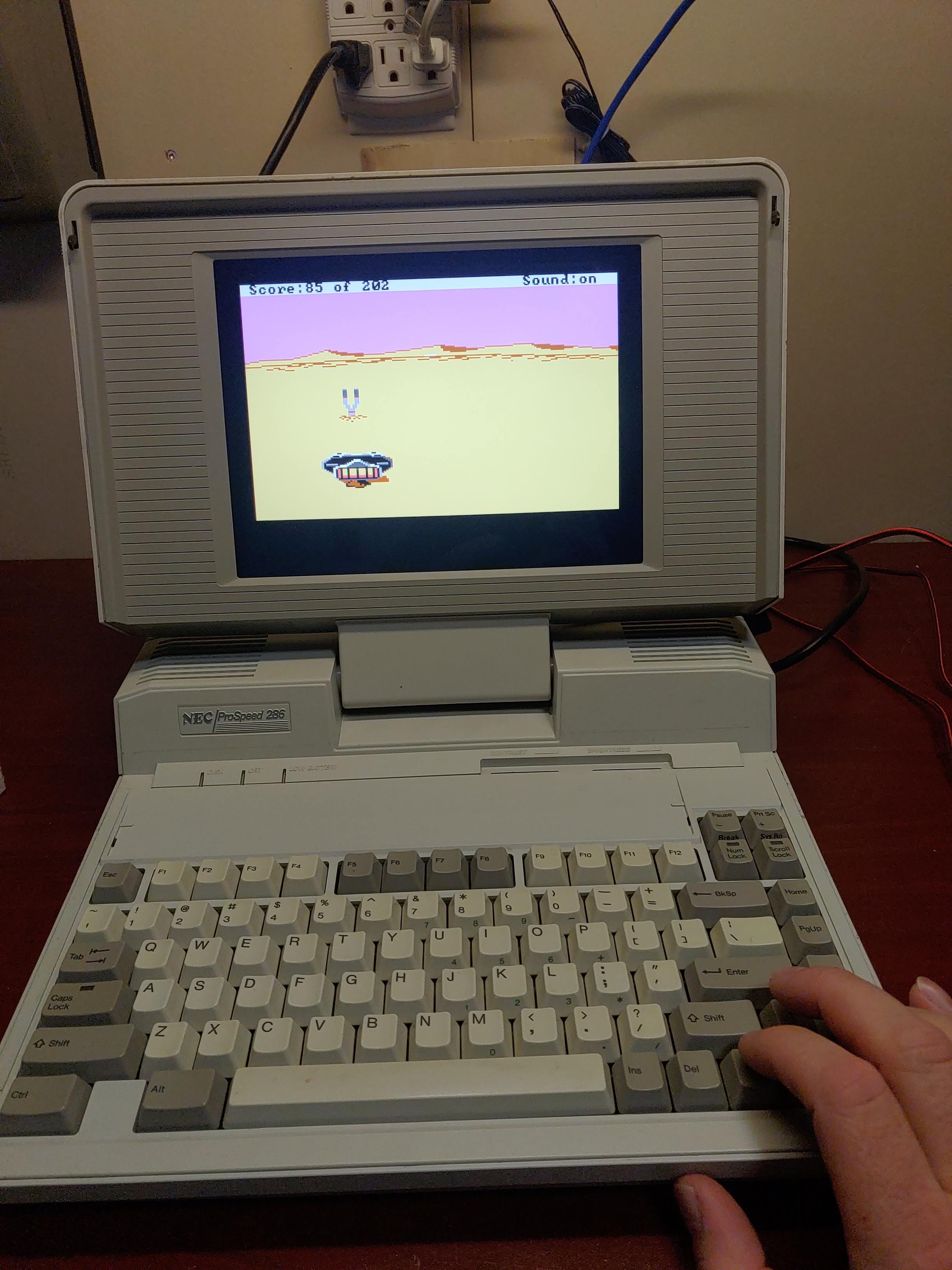
Externally, it looks pretty well stock, and [Cory] has retained as much of the internals as possible. The original power supply remains intact, with power taken off the original HDD’s molex connector. Said power drives a Raspberry Pi, which is small enough to fit inside without any gutting. The original keyboard connects easily enough via a PS/2 to USB adapter, while the passive-matrix LCD has been replaced with a modern screen of the same dimensions. You’d have to be a pretty hard-core purist to mourn that last change.
With emulation on the Pi, he can still have the DOS experience you’d expect from this machine, but its also powerful enough to be useful in the modern day. While we place no bets on whether or not this mod will stay relevant for another 38 years, a more powerful single-board computer or slightly-squished cell phone can be placed in the drive bay instead once the Pi’s ARM processor inevitably starts to look as anemic as the 286 does now.
Not everyone loves this kind of restomod, but we’ve featured more than a few and have a special category for it in our ongoing retrocomputing contest for those who will do everything to keep classics out of the e-waste bin, including remaking them.

SQLite 3.54 Released With Faster Performance, Drops Windows XP Support
SQLite 3.54 released today for this wildly popular embedded SQL database engine used by countless applications and other software. With SQLite 3.54, support for Microsoft Windows XP and older is finally removed...
Embedded 3D Printing with Liquids on a Bricked Prusa FDM Printer
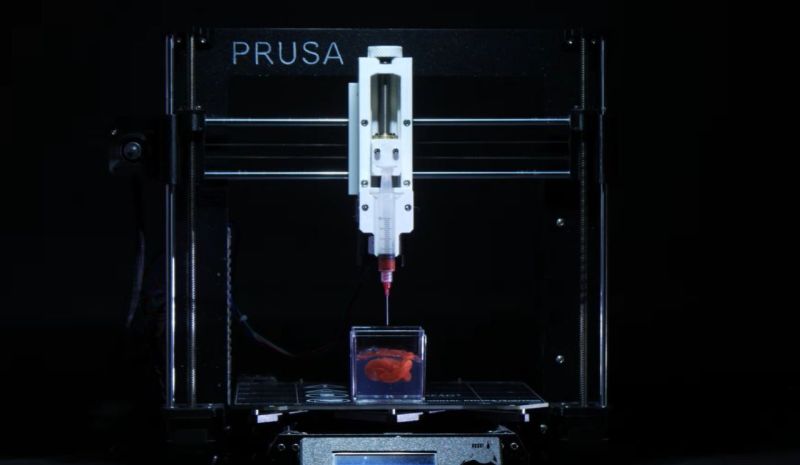
Recently [Riley] got his paws on an old Prusa i3 FDM printer that had clearly seen better days, with a hot-end that had suffered an explosive blow-out. For the project he had in mind this was of course perfect, as his intention was to replace the hot-end with a syringe system for embedded 3D printing (E3DP), which uses a supportive medium to allow for the printing of materials and structures that would be impossible with just air.
Generally in additive manufacturing (AM) methods like fused deposition modelling (FDM) the material is extruded onto a build plate or a previous layer where it solidifies. This works great for materials like thermoplastics, but for other materials having only the surrounding air as support is just a recipe for a big mess. With E3DP the liquid is instead extruded into a supportive material at a selectable depth and volume, opening up a whole range of possibilities.
In a 2026 review article by [Rongji Tang] et al. in Frontiers in Materials provide an overview of the state-of-the-art in E3DP, including many ongoing research questions pertaining to print quality, the types of supportive material and their potential reuse, as well as extrusion control. Applications for E3DP are many, with it seeing use in flexible- and soft robotics, printing biological tissues and microfluidics.
While some types of fluids are easier to print than others, Newtonian fluids like silicone oil pose issues with reliable printing, as detailed by [Hejoon Jun] et al. in a 2025 paper in Applied Materials & Interfaces, while a 2026 paper by [Min Ye] et al. in International Journal of Extreme Manufacturing covers the challenges of printing living tissues this way, with a self-healing supporting medium described, creating a method called EPICS.

In the video by [Riley] the fundamentals are explained in a comprehensive manner, before building an E3DP setup, with an open source Allstruder syringe pump and a Caribou Duet 3 motherboard replacing the Prusa parts. Following this a test print is made using cream cheese as it’s apparently an ideal test material.
After a successful cream cheese test, a print is started involving two-part epoxy, with the supporting material being hair gel. The epoxy, once mixed, has only a time window of about forty minutes before it hardens, so that’s all the time you have to empty the syringe. As it turns out, hair gel and epoxy aren’t friends, so for a final print the printing material was switched to silicone, specifically Sylgard 184.
Although not a perfect result, it’s pretty cool to see the silicone trifold torus take shape in what appears to be a void. Unfortunately the hair gel doesn’t appear to be a perfect material either, as some of the additives in it apparently inhibit the silicone from curing. As reported by [Riley] in a comment to the video, the silicone print was still goopy after a few days.
We hope that it’ll cure before long, and wish him luck in finding a supporting material that’s more supportive of printing materials like silicone actually curing.
Neanderthal wooden tools from Spain found preserved in stone
The Stone Age owes its name to tools that survived to our time. The material early humans worked with most, though, was probably wood because it is so much easier to process. Unfortunately, we know very little about Paleolithic woodwork because wood rots relatively quickly. But at Abric Romaní, a rock shelter in Capellades, west of Barcelona, mineral-rich water coated wooden Neanderthal tools in a limestone-like crust. When wood rotted away, it left behind hollow molds that faithfully reflect its shape.
In a recent Science Advances study, a team of Spanish archaeologists has cataloged 597 wooden remains from Neanderthal living areas dating from 62,000 to 40,000 years ago. They found spears, digging sticks, bark trays, parts of shelters, and a club unlike anything seen before, suggesting Neanderthals were likely much more than just Homo sapiens’ dumber cousins.
Beyond hunting gear
The oldest wooden artifacts we have are mostly weapons. They include spears from a German town called Schöningen, a spear tip from Clacton-on-Sea in England, and the spear found alongside an elephant skeleton in Lehringen, Germany. Most came from waterlogged sediments, where a lack of oxygen slowed decay.
Ukraine’s drones knock out AI data center belonging to "Russia’s Google"
Ukrainian drone strikes have knocked out two of five data centers belonging to the Russian tech giant Yandex. The damage has left Yandex, known as “Russia’s Google” because it operates the country’s most popular search engine, struggling to maintain its AI chatbot and other online services.
The Ukrainian drones struck Yandex data centers in the Sasovo and Kaluga regions of Russia on October 8 and October 9, according to Reuters. Those actions came as a direct response to a Russian drone strike campaign targeting Ukraine’s data centers, which has disrupted mobile phone and Internet services for thousands of Ukrainians since late September.
“We continue to respond to Russia’s attacks on Ukraine, and we’re doing so with high precision,” said Ukrainian President Volodymyr Zelenskyy in a post on X. “Another data center was hit as well—our symmetrical response.”